
Blog


July 13, 2026
A Conversation with José Villalobos
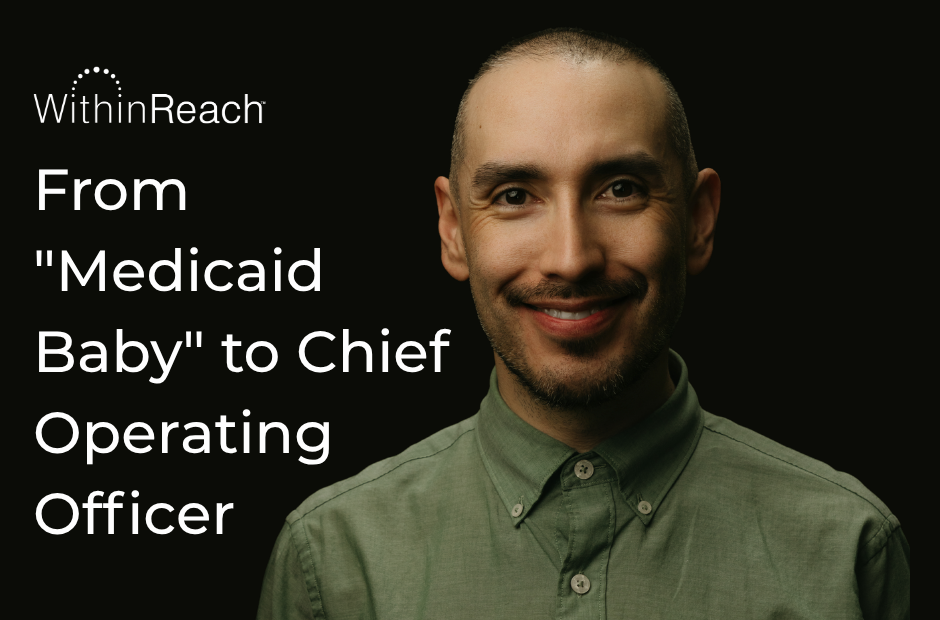
At WithinReach, we often talk about how the right resource at the right time can change the entire trajectory of a family’s life. For our new Chief Operating Officer, José Villalobos, that isn’t just an organizational creed—it is his story.
We sat down with José to reflect on his journey, how growing up in a rural migrant farm-working community shaped his leadership, and what it means to lead the very systems that once saved his life.
Let’s start at the beginning. Can you tell us a little about your family, where you’re from, and what it was like growing up there?
José Villalobos: I was born and raised in the countryside of Walla Walla, Washington. I’m the youngest of four children and have three older sisters. My parents met in Tijuana, Mexico, where my oldest sister was born. In 1976, having heard from family members that there were good agricultural job opportunities in the Walla Walla Valley, they made the move.
We lived in a 46-acre community in the southern Walla Walla countryside called the Walla Walla Farm Labor Camp (which was later renamed Valle Lindo, meaning “Beautiful Valley,” in 2011). Growing up, it truly felt like its own little city because we were so physically and socially removed from the rest of the town. It was an insular, microcosm of society.
As a child, I didn’t have the capacity to understand how our small community of primarily Spanish-speaking migrant farm-working families was doing our best to thrive while navigating deep adversities—low incomes, housing instability, and substance use disorders. But I did have the capacity to understand that things could be better for my community, neighbors, friends, and family. I just didn’t know yet what that meant from a public policy or systems-level perspective.
You mentioned that the community was highly isolated, but that there were strong efforts to bring resources directly to you. How did that impact your early life?
José Villalobos: Because we were so rural, local organizations made a real effort to bring resources straight to us. They actually put a Migrant and Seasonal Head Start (MSHS) Center right inside our community. I was a “Head Start baby” from birth up to age 5. There were after-school programs, summer programs, and initiatives to address hunger.
When you’re a child it’s more difficult to understand that these are “nonprofit programs” or systemic interventions—you just know you are being cared for and as an adult, you come to realize that these supports make a difference. It wasn’t until my parents were financially able to move us out of the camp when I was 12 that I began to see the massive differences in community design and how resources are distributed. That transition into middle school really sparked my curiosity about why some communities have access to support and others are left isolated.
You have shared that you are a Medicaid and WIC baby. Looking back, what does it mean to you to now help lead an organization that connects families to those exact same resources?
José Villalobos: This is truly the most gratifying and fulfilling aspect of my career. When I first joined WithinReach back in October of 2012, I was in the direct service department, working on the front lines to ensure families across Washington State were informed and enrolled in these exact programs.
For people who see the WIC tags at the grocery store but don’t know much about it, WIC is a life-saving, life-sustaining nutrition program. It provides formula, healthy food, lactation support, and health screenings. The data proves it reduces infant mortality and premature births. It gave me a healthy start.
But Children’s Medicaid? That was literally a life-saving resource for me.
How did Medicaid save your life?
José Villalobos: I have a very vivid memory of it because the trauma and the pain were so intense. I was four years old, and what my parents thought was just a bad stomach ache or indigestion rapidly progressed into a life-threatening emergency within hours.
My mom took me to a walk-in clinic to see my pediatrician—who, coincidentally, was the same doctor who delivered me. While we were at the clinic, my appendix ruptured. I was rushed into emergency surgery. When I was older, my parents told me that the doctors gave me a 50/50 chance of surviving the post-surgery recovery because the risk of sepsis and peritonitis was incredibly high.
I ended up spending a little over two weeks in the hospital under intense monitoring before making a full recovery. Because I was four, my memories are of the “great” parts—playing the Nintendo NES system in the hospital room, receiving a box of chocolates and a teddy bear from my mom’s friend, and visits from extended family. I didn’t realize I was on the brink of death. I still carry the physical scar from that surgery today.
But here is the piece that connects directly to what we do at WithinReach: because my parents had Medicaid coverage for us, they could focus entirely on saving my life. They didn’t have to hesitate at the door out of fear of a $100,000 hospital bill. My mom was so incredibly diligent about keeping our immunization cards updated and getting us to well-child checkups because Medicaid made healthcare accessible and free to us. Had that resource not been there, the outcome for my family and me would have looked devastatingly different.
How did that lived experience translate into your career when you were out doing direct outreach for WithinReach?
José Villalobos: Around 2014 and 2015, I was doing rural outreach in collaboration with the Washington State Department of Health, traveling to tiny communities to educate Spanish-speaking families about developmental screenings for their kids.
We set up an event at a small community center just outside the Tri-Cities, and the second I walked in, it felt like stepping right back into my childhood. Because I had lived that life, I was able to build rapport with those families almost instantly. I could look at them and say, “I grew up in the Walla Walla Farm Labor Camp. My family used these exact same food and medical coupons to get by.”
Stigma around public benefits has always existed, and it probably always will. It’s a societal issue—the perception of giving our neighbors help when they face adversity. But what we can change is awareness. When families are living in an isolated bubble, they don’t always know what they can tap into. Showing up as someone who came from that same setting, who survived and thrived because of those programs, breaks down doors. These programs are big, vital steps that help families progress—especially those who are new to this country and trying to figure out how to navigate a completely unfamiliar system.
From starting on the phone lines and doing rural outreach in 2012 to now becoming the Chief Operating Officer in 2026—how does that trajectory influence your vision for the future of WithinReach?
José Villalobos: When you understand the micro-level relief a parent feels when their child gets health insurance, it changes how you look at macro-level operations. Every data point we track, every system we build, and every budget we manage at WithinReach ultimately impacts a family just like mine. As I step into the COO role, I want to ensure our organization remains deeply rooted in that human reality, building a resource-rich environment where no family is left to struggle in isolation.
As you step into the COO role, how are you thinking about your responsibility not only to the families WithinReach serves, but also to the staff and emerging leaders doing this work alongside you?
José Villalobos:
My approach to leadership is grounded in connection, learning, and meeting people where they are.
I value learning information and being able to share it with as many people as possible – not necessarily in a structured and educational setting but through genuine conversations and connections. That said, my own formal education has deeply shaped how I approach this work. I earned my Master of Public Administration from Seattle University while working here at WithinReach full-time, and I’m incredibly grateful for that experience. It’s a fantastic in-person program where I met amazing people and gained a much deeper understanding of the sectors we interact with daily, which really prepared me for these kinds of organizational leadership opportunities.
I attended the University of Washington, where I got a Bachelor of Arts in International Studies focused on Latin American Studies. UW opened my eyes to systems, politics, and economics at a macro-level, which helped me understand how to bridge the gap between those massive, sweeping systems and the micro-level solutions we build every day to support Washington families.
I hope to continue creating opportunities to connect with people of all ages, particularly those who are on healing journeys and trying to understand the traumas that come with being first-generation immigrants.
I also feel a responsibility to reach younger generations to share more about my life experiences and help them unlock and tap into their hidden potential as future change-makers and the architects of their own destinies. While each of us has our own story, many of our experiences connect us. By sharing those experiences and supporting one another, we can help create stronger communities and better outcomes for future generations.